Code quality
This page describes the day-to-day code quality cycle of the project: how the four tools chosen during the refactoring (uv, ruff, pyright, pre-commit) work together while you write code, until the commit is accepted.
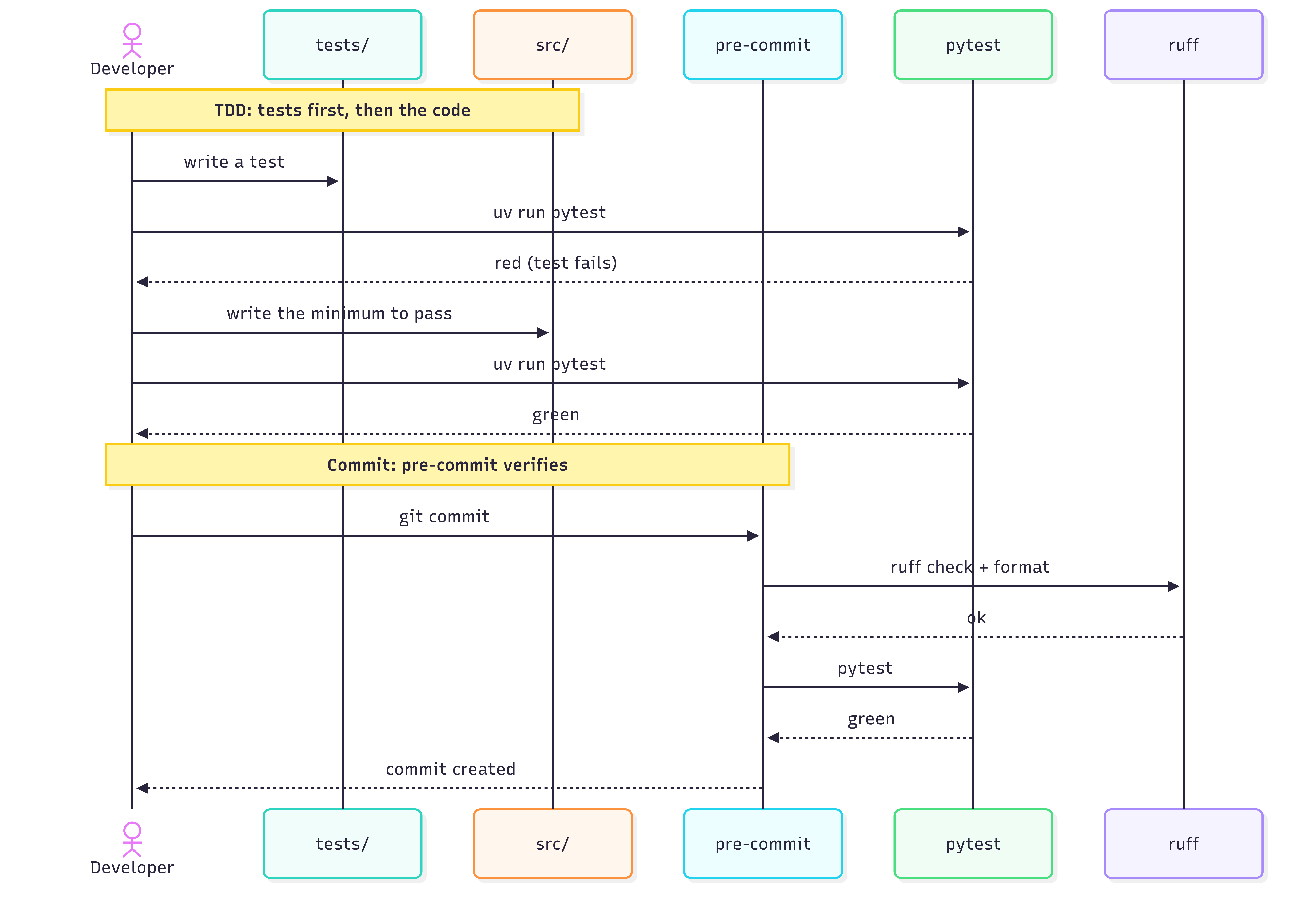
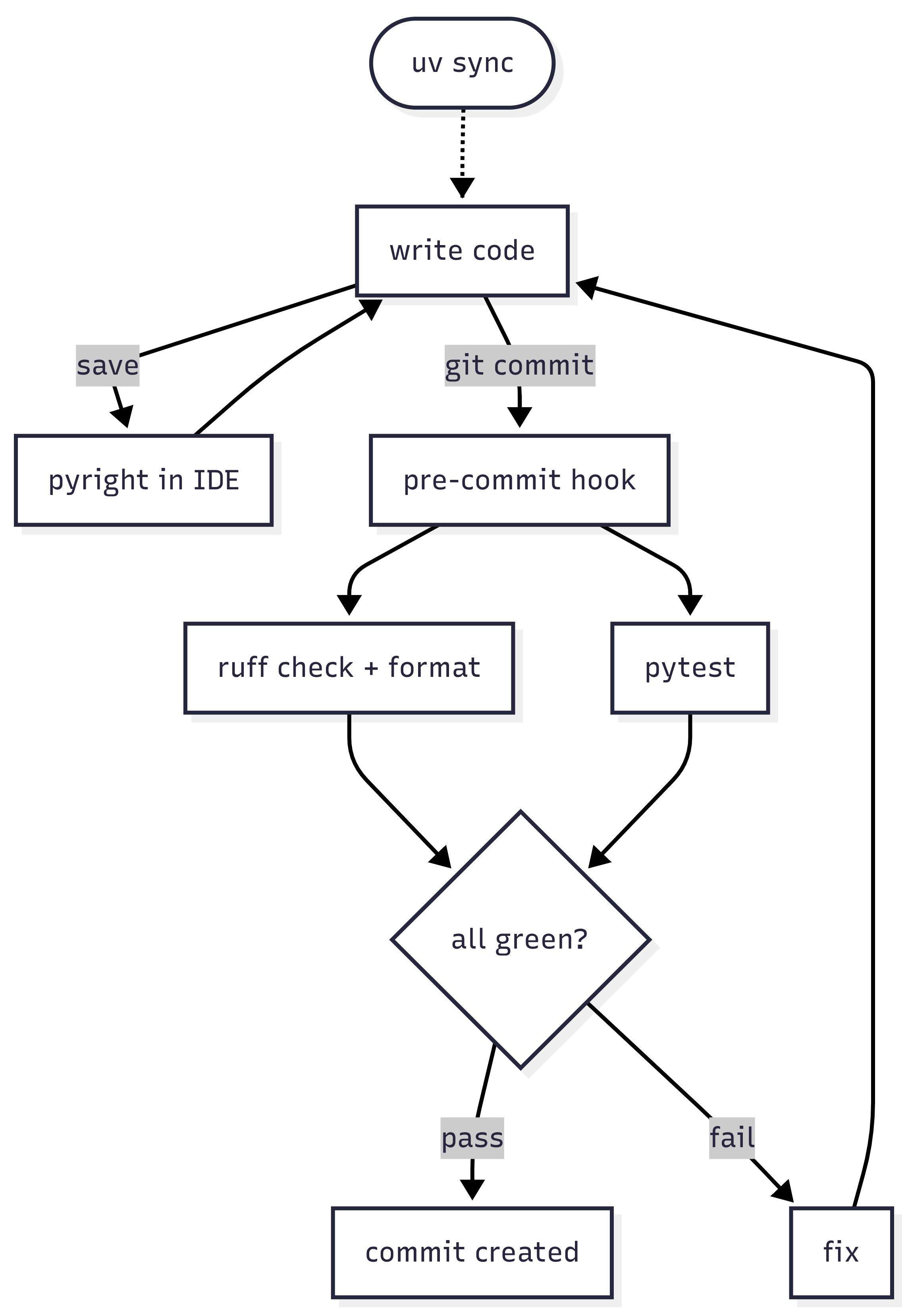
Two views from two angles. The first one is a flowchart that shows the cycle from the perspective of the tools: who runs when, where each one fits, and what happens at the all green ? fork. The second one is a sequence diagram that shows the cycle from the perspective of time: tests are written first, then the code, and pre-commit verifies again at git commit.
The cycle of the four tools
The flowchart below shows the daily cycle of the four tools. uv sync (dotted) is the initial setup, not part of the daily loop. While you write code, pyright runs in real time inside the IDE (typically via Pylance on VS Code). When you git commit, the pre-commit hook fires ruff check + format and pytest: if all green, the commit is accepted; if not, you fix and the loop starts again.
For the configuration of each tool see howtomake / Test tools; for the story of why these tools were chosen see refactoring (Step 6 to Step 10).
The TDD sequence
The sequence diagram below shows the same cycle from a temporal angle, focused on TDD. The order matters: pytest works only if the tests exist, and tests are written before the code. The first part of the sequence (Dev, tests/, src/, pytest) is the TDD loop in local: write a test, see it red, write the code, see it green. The second part (Dev, pre-commit, ruff, pytest) is the verification at git commit: pre-commit runs the same tools again as a safety net before the commit is accepted.
For examples of pytest tests in this repo see howtouse / PyTest; for the conversion of unit tests from unittest to pytest see Step 5 of the refactoring page.